Agentic Payments in 2026: 7 Protocols, x402 vs Card Rails, and What Australia Needs
Agentic payments in 2026: x402, AP2, MPP, ACP, TAP, UCP and PayPal Agent Ready compared. Card rails vs stablecoins, and AI agent payments in Australia.
In 2026, AI agents can pay for things. They pay for data, for compute and for goods. This new market has a name: agentic payments.
There is no single standard. We count seven protocols and services that compete to carry AI agent payments. Each one comes from a different part of the payments industry. Each one protects a different business model.
This article compares the seven. It explains the main strategic split: card rails against stablecoin rails. It gives the current x402 statistics, with sources. It also explains the gap for AI agent payments in Australia, and what Milypay does about it.
For a deeper comparison of two of the protocols, read x402 vs MPP. For the Australian decision map, read Stripe MPP, Tempo, and x402 on Solana.
The seven agentic payment protocols at a glance
Sources: x402 Foundation launch, AP2 (TechCrunch), ACP (OpenAI), TAP (Visa Developer), UCP (Axios), MPP (Stripe), Agent Ready (PayPal Developer), PayPal newsroom.
Note: PayPal Agent Ready is not a new wire protocol. It is a merchant service. It connects PayPal and Braintree merchants to ACP and UCP. We include it because many merchants will meet agentic payments through it.
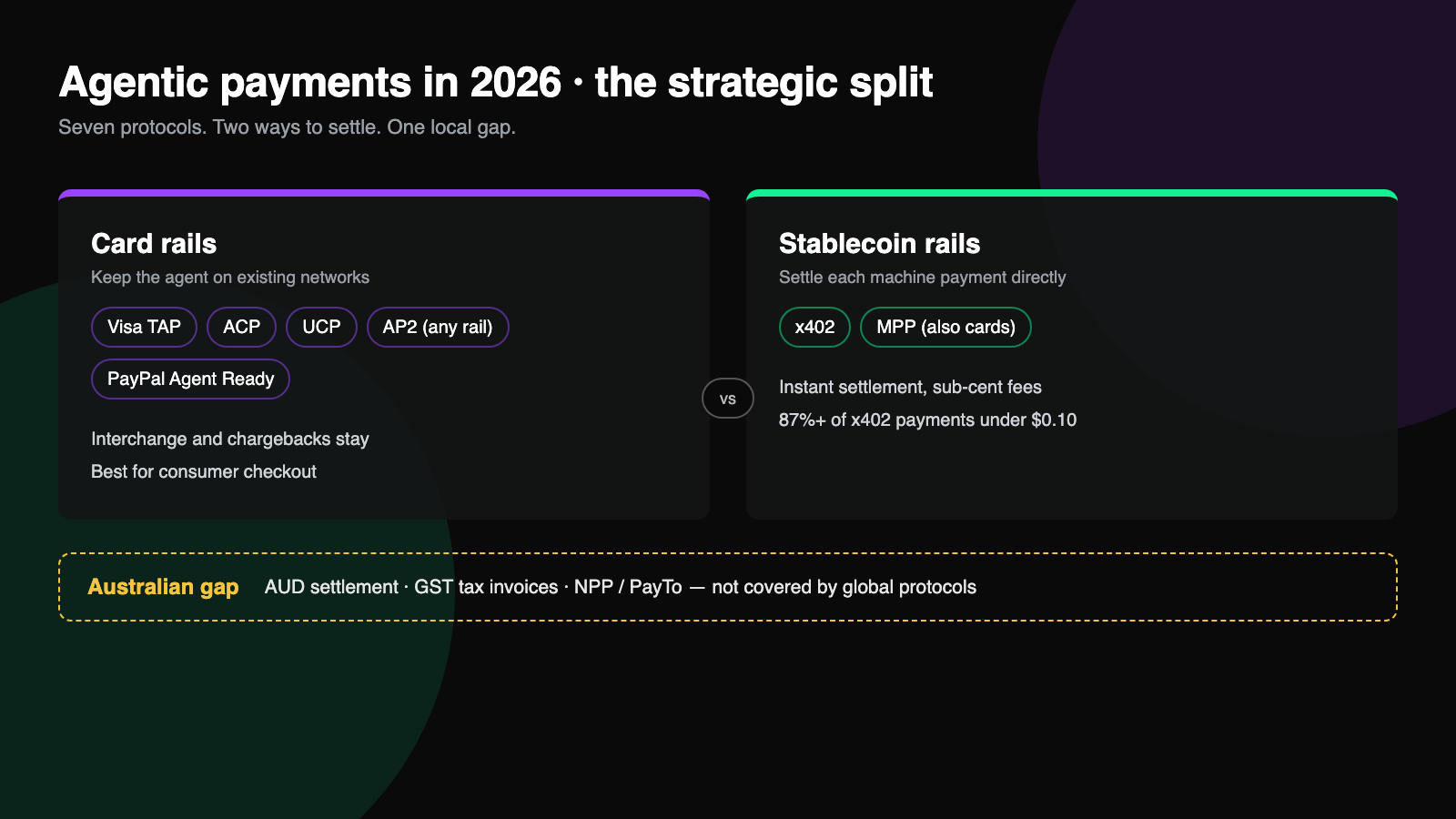
The strategic split: card rails vs stablecoin rails
The seven protocols fall into two groups. The groups do not agree on who settles the money.
Card rails: keep the agent on the existing network
Visa TAP is the clearest example. TAP does not move money in a new way. It lets a merchant verify that an agent is trusted and has commerce intent. Then the agent can carry a payment credential to a normal checkout (Visa TAP specification).
ACP, UCP and PayPal Agent Ready follow a similar pattern. The agent changes the shopping experience. The payment still goes through cards, wallets and processors. AP2 adds signed mandates, so issuers and networks can see that an agent was present.
Our analysis: this design keeps the card network in the payment path. That also keeps interchange and the current fee model. It also keeps chargebacks and buyer protection, which consumers value. For an A$300 furniture order, that is a strong position.
Stablecoin rails: settle each machine payment directly
x402 takes a different approach. A server returns 402 Payment Required with a price. The agent pays in a stablecoin and sends the request again. Settlement is on-chain and fast. The fee can be a fraction of a cent.
This changes what a payment can be. Chainalysis says payments under one dollar "don't make fiscal sense for a credit card network to process". Stablecoins that cost less than a cent to settle make these payments possible (Chainalysis).
MPP sits between the two groups. It uses HTTP 402 like x402. But it also accepts cards and buy now pay later through Stripe Shared Payment Tokens (Stripe).
The split is not clean
The card networks also hedge. Visa, Mastercard and American Express are premier members of the x402 Foundation. The Foundation says x402 will support "traditional cards to stablecoins". So the real question is not "cards or crypto". The real question is: which rail settles which kind of payment?
Our view: cards will keep large consumer orders. Stablecoins will take high-volume, low-value, machine-to-machine payments. An agent that buys 500 API calls at A$0.003 each cannot use a card for each call.
x402 in numbers
The x402 numbers are large. But each number counts a different thing. Read the source before you use a number.
The last row is important. TRM Labs found $52.7M across 198.9M settlements. After TRM removed self-payments and other unusual flows, $25.6M stayed. TRM estimated that only 0.6% to 7.5% of that value came from AI agents. So the headline numbers show that the rail works. They do not yet show a large agent economy.
The most common x402 payment was between one and ten cents. That is the market that card rails cannot serve at a profit.
The x402 Foundation
In April 2026, Coinbase gave x402 to the Linux Foundation. In July 2026, the x402 Foundation started formal operations with 40 members.
Premier members include Visa, Mastercard, American Express, Stripe, AWS, Google, Circle, Shopify, Cloudflare, Coinbase, Adyen, Fiserv and the Solana Foundation.
This is important for three reasons:
- Neutral governance. No single company controls the specification.
- Card networks are inside. Visa and Mastercard help to write the standard. They do not only compete with it.
- Lower risk for builders. An x402 integration is less likely to become an orphan.
Solana's position in x402
Base was the first home of x402. In 2026, Solana took a large share.
- About 70% of monthly x402 volume was on Solana in mid-August 2026 (Crypto Briefing).
- 76% of x402 transactions were on Solana from 22 August to 19 September 2026. That was 23.2 million, against 3.39 million on the next network (Solana Foundation).
- Payment channels went live on Solana on 3 September 2026. In a benchmark, 100,000 wallets sent more than 1 million payments per second through a payment channel proxy (Solana).
- BlockRun, which the Solana Foundation calls the largest x402 server, ran more than 60 million transactions in two months on Solana (Decrypt).
Payment channels solve a real problem. Without them, each paid call is one on-chain transaction. With a channel, the agent sets a spending limit once. It signs many small payments off-chain. It settles once at the end. Payment channels work with x402 and with MPP sessions.
Note: the 1 million payments per second figure is a benchmark from the Solana team. It is not live traffic.
The share numbers change quickly. Chain share also depends on the data source and on the date range. Before 25 August 2026, Base led daily x402 transaction counts for about six months (Crypto Briefing).
Security: five attacks on x402
In May 2026, researchers from Ohio State University, CSIRO (Australia) and the University of Manchester published "Five Attacks on x402 Agentic Payment Protocol". They tested on local chains, on Base Sepolia and on live endpoints. They also audited three open-source SDKs.
The five attacks:
- Revert-grant. The server gives the resource before the payment is final. The payment then fails.
- Settlement preemption. An observer uses the payment authorisation first. The user pays but does not get the service.
- Replay. The server does not record the payment identity. In a live test, one payment unlocked 248 grants.
- Header and proxy confusion. Caches and proxies leak paid content. The researchers confirmed a leak through a live CDN.
- Server-selection attacks. False metadata and Sybil servers send agents to a malicious endpoint. One crafted server got 71.8% of agent selections.
The paper also gives mitigations. If you run an x402 server, do these steps:
- Record each payment ID before you return the resource.
- Bind settlement to the correct caller.
- Set
Cache-Control: no-storeon paid responses. - Do not give the resource before the payment is final, or reserve funds first.
- Do not trust discovery metadata without checks.
The fragmentation risk
Seven protocols are too many for most merchants. Each protocol needs integration work, tests and support.
The market already shows this cost. PayPal built Agent Ready so that merchants do not need "separate integrations" for ChatGPT, Google AI Mode and Gemini (PayPal). That is a service whose main job is to hide fragmentation.
There is also a measurement problem. Trackers give different numbers for the same protocol. Crypto Briefing reported cumulative x402 estimates from 120 million to 187 million transactions, "depending on which tracker you consult".
Our advice for builders:
- Pick by payment type, not by brand. Use card protocols for consumer checkout. Use x402 or MPP for per-call machine payments.
- Support two rails where it is cheap. Milypay accepts x402 by default and MPP on request.
- Keep your core logic separate from the protocol. Then you can add a new protocol later.
AI agent payments in Australia: the local rail gap
The global protocols solve global problems. They do not solve three Australian problems.
1. AUD settlement
Most x402 payments are in USD stablecoins. An Australian business that sells to an agent wants AUD. A USD payment adds FX risk and accounting work. For more, read why Australia needs its own stablecoin and the 2026 stablecoin builders guide.
2. GST records
If a customer asks for a tax invoice, a GST-registered business must give one within 28 days. This rule applies to sales over A$82.50, including GST (ATO). A business buyer needs that tax invoice to claim a GST credit (ATO). None of the seven protocols makes an Australian tax invoice. Each merchant must solve this.
3. The NPP and PayTo
Australia has its own real-time rail. The New Payments Platform (NPP) connects more than 100 banks and fintechs. It settles payments in real time, 24/7. PayTo lets a business start an authorised debit from a customer's bank account. PayTo agreements are a good match for agent spending limits. We found no public NPP or PayTo integration in any of the seven protocols.
Where Milypay fits
Milypay is an x402 service provider for the Australian market. AI agents pay per call for Australian data: ABN and ASIC records, G-NAF addresses, BSBs, ABS statistics, transit, NEM energy and more. There are no API keys and no signup.
What Milypay does today:
- AUD-native settlement. Milypay accepts AUDD, AUDM and dAUD on Solana. It also accepts USDC and USDT.
- x402 by default, MPP on request. Read how Milypay runs both rails.
- Sub-cent prices. Most data calls cost $0.001 to $0.004 each (agents.md).
- Agent tools. There is a CLI, an MCP server and an SDK.
What Milypay does not do yet:
- Milypay does not connect to the NPP or PayTo. Agents fund wallets with stablecoins.
- Milypay does not issue GST tax invoices for each call.
These two items are the rest of the local rail gap. The global protocols do not cover them, and Milypay does not cover them yet. Milypay covers the first part today: AUD settlement for Australian data. To see a full Australian agent purchase, read agentic payments in Australia: from a photo to a Kmart delivery.
FAQ
What are agentic payments?
Agentic payments are payments that an AI agent starts for a person or for a business. The agent finds a price, gets authority, pays, and gets the product or the data. A person can set limits before the agent starts.
What is x402?
x402 is an open protocol for payments over HTTP. A server sends HTTP 402 Payment Required with the price. The client pays, usually in a stablecoin, and sends the request again with proof of payment. The x402 Foundation at the Linux Foundation now manages the protocol. For a primer, read x402 on Solana.
How many agentic payment protocols are there in 2026?
This article compares seven. They are x402, Google AP2, MPP from Stripe and Tempo, ACP from OpenAI and Stripe, Visa TAP, UCP from Google and Shopify, and PayPal Agent Ready. Agent Ready is a merchant service that uses ACP and UCP. It is not a separate wire protocol.
Which blockchain has the most x402 payments?
It depends on the period and on the data source. Chainalysis counted more than 138 million x402 transactions on Base in the 12 months to 1 July 2026. Solana had approximately 70% of monthly x402 volume in mid-August 2026.
Is x402 secure?
x402 is new and it has known risks. A May 2026 paper showed five practical attacks on x402 designs and SDKs. The paper also gives mitigations, for example idempotency, settlement before access, and correct cache rules.
Can AI agents pay in Australian dollars?
Yes. Milypay accepts AUD stablecoins on Solana over x402 for Australian data APIs. The global protocols do not give a native connection to the NPP, PayTo or GST tax invoices.
Further reading
- x402 vs MPP: How AI Agents Actually Pay on the Web
- Stripe MPP, Tempo, and x402 on Solana
- x402: The HTTP Payment Protocol for Solana AI Agents
- Milypay: What Just Shipped
- Case study: shipping Milypay
Work with us
Milysec designs and ships agentic payment systems in Australia. Do you need x402, MPP or an AUD payment flow for your agents? Contact the studio, or try the live API at milypay.xyz.
Studio
About Milysec
Milysec is an Australian venture studio building at the intersection of AI and Solana. We ship products and infrastructure that make programmable finance and agentic systems usable in Australia.
Learn more about Milysec →